
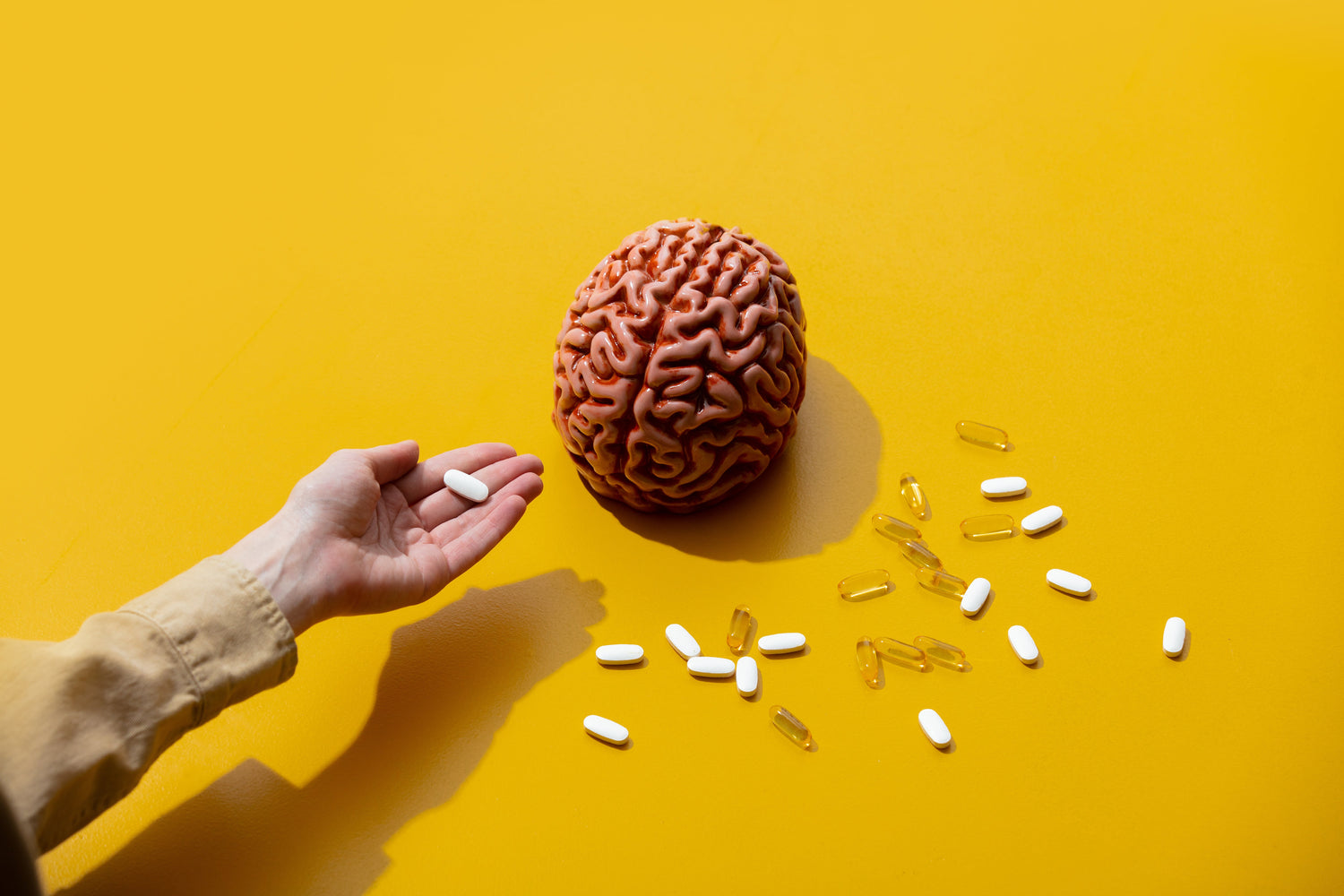
The short version: "nootropic" is a big umbrella term that covers everything from prescription medication to the ginseng in your grandmother's tea. BRAiNLUBE only plays at the natural, food-based end of that spectrum — here's what that means and how to try it for the first time without overthinking it.
So, What Exactly Is a Nootropic?
You've probably heard the word thrown around — on a podcast, a supplement label, maybe a coworker who swears their morning stack makes them "lock in." But "nootropic" isn't a single ingredient or a single product category. It's an umbrella term for anything believed to support cognitive function: focus, memory, mental clarity, alertness, that general feeling of "on."
That's a wide umbrella. Under it, you'll find prescription drugs developed to treat medical conditions. You'll find synthetic compounds engineered in a lab specifically to sharpen cognition. And you'll also find plants, roots, and amino acids that humans have been using for centuries, long before anyone coined the word "nootropic" in 1972.
In other words, the term tells you almost nothing about what's actually in the bottle. Two products can both be marketed as "nootropics" and have absolutely nothing else in common — one might require a prescription, the other might be sitting next to the herbal tea at the grocery store.
The Nootropic Spectrum, From Pharmacy to Produce Aisle
The pharmaceutical end
On one side of the spectrum are prescription nootropics — medications developed and approved to treat specific diagnosed conditions, like attention disorders or narcolepsy. These are real drugs, regulated as drugs, with real risks, real side effects, and real reasons you need a doctor's involvement to use them. They are not health drinks. They are not "just supplements." They belong in a medical context, prescribed and monitored by a professional.
The synthetic stimulant middle
In the middle, you've got synthetic compounds and stacks that aren't prescription drugs but also aren't found in nature — lab-formulated stimulants, novel synthesized compounds sold under supplement labeling. This is the territory where a lot of "smart drug" hype and biohacker forum chatter lives. Some of it is reasonably well understood. A lot of it is not.
The natural, food-based end
And then there's the end of the spectrum where BRAiNLUBE lives: natural, plant- and food-based compounds that have a long history of traditional use or common presence in the diet. Things like guarana seed extract, ginseng root, ashwagandha, bacopa monnieri, ginkgo biloba, green coffee bean extract — plus amino acids your body already produces or uses, like taurine, L-theanine, L-citrulline, and L-tyrosine. Research on these ingredients is often described in hedged terms for good reason — "commonly studied for," "traditionally used to support" — rather than hard clinical guarantees. That's not a weakness, it's just honesty about where natural-compound science currently stands.
"Nootropic" is a category, not a promise. What's actually in the can is what matters.
Why BRAiNLUBE Stays at the Natural End
We're not a pharmaceutical company, and we're not trying to blur the line into looking like one. BRAiNLUBE is built entirely from natural, food-based nootropic ingredients — the BRAiNLUBE Energy Blend of taurine, guarana seed extract, ginseng root extract, green coffee bean extract, ashwagandha root extract, L-citrulline, bacopa monnieri, L-tyrosine, ginkgo biloba, L-theanine, and inositol — alongside 130mg of caffeine per can from natural sources. That's roughly what you'd get from a strong cup of coffee.
The goal isn't to chase the strongest possible cognitive effect through synthetic engineering. It's clean, sustained energy without the sugar crash and jittery spike that typical energy drinks are built around. The L-theanine pairing in particular is included to work alongside the caffeine — it's commonly discussed as a way to take the edge off caffeine's jitteriness, so you get the alertness without the shakiness.
| Category | Examples | Where BRAiNLUBE Fits |
|---|---|---|
| Prescription nootropics | Medications for diagnosed conditions | Not this. Requires a doctor, not a can. |
| Synthetic compounds/stacks | Lab-formulated, novel stimulant blends | Not this either. Not what's in the can. |
| Natural, food-based compounds | Ginseng, ashwagandha, taurine, L-theanine, real caffeine | This is BRAiNLUBE. Whole-source ingredients only. |
Trying Nootropics for the First Time: A Few Ground Rules
If all of this is new to you, good news — you don't need a chemistry degree to get started responsibly. A few simple habits go a long way.
Start simple. Your first move into nootropics doesn't need to be an elaborate stack of six different supplements. One well-formulated product, taken as directed, is plenty to figure out how your body responds.
Know your caffeine tolerance. Most nootropic energy drinks, BRAiNLUBE included, include caffeine as part of the formula. If you're caffeine-sensitive, or you already drink a lot of coffee, that matters more than any of the other ingredients on the label. Pay attention to total caffeine across everything you consume in a day, not just the one can.
One new thing at a time. If you're trying a new nootropic product, it's smart to avoid also introducing three other new supplements the same week. That way, if something feels off — or great — you actually know what caused it.
Timing matters. A 130mg-caffeine drink in the early afternoon is a very different experience than one at 9pm. Reach for it on days that actually demand more — deep work, a long drive, exam prep, back-to-back meetings — rather than making it a background daily habit.
Respect the label. Limit yourself to two 12oz cans daily. This isn't intended for anyone under 18, and it's not recommended for people who are sensitive to caffeine, pregnant, or nursing. These aren't fine print — they're the actual guardrails.
Give it an honest trial. Natural compounds tend to work more gradually and gently than synthetic stimulants. Don't expect a dramatic jolt on can one. Notice how you feel — focus, steadiness, whether the crash you're used to shows up or doesn't — over a handful of uses before you decide it's not for you.
The Bottom Line
"Nootropic" is a category, not a guarantee, and it spans everything from prescription medicine to the herbs in your kitchen cabinet. BRAiNLUBE was built deliberately at the natural, whole-source end of that spectrum — real ingredients with long histories of traditional use, paired thoughtfully with real caffeine, instead of a sugar-and-synthetics stack. If you're nootropic-curious and looking for a low-stakes place to start, a can that's honest about what's in it — and what it isn't — is a reasonable first step.
Sip smarter. Live brighter.
These statements have not been evaluated by the Food and Drug Administration. This product is not intended to diagnose, treat, cure, or prevent any disease.
