
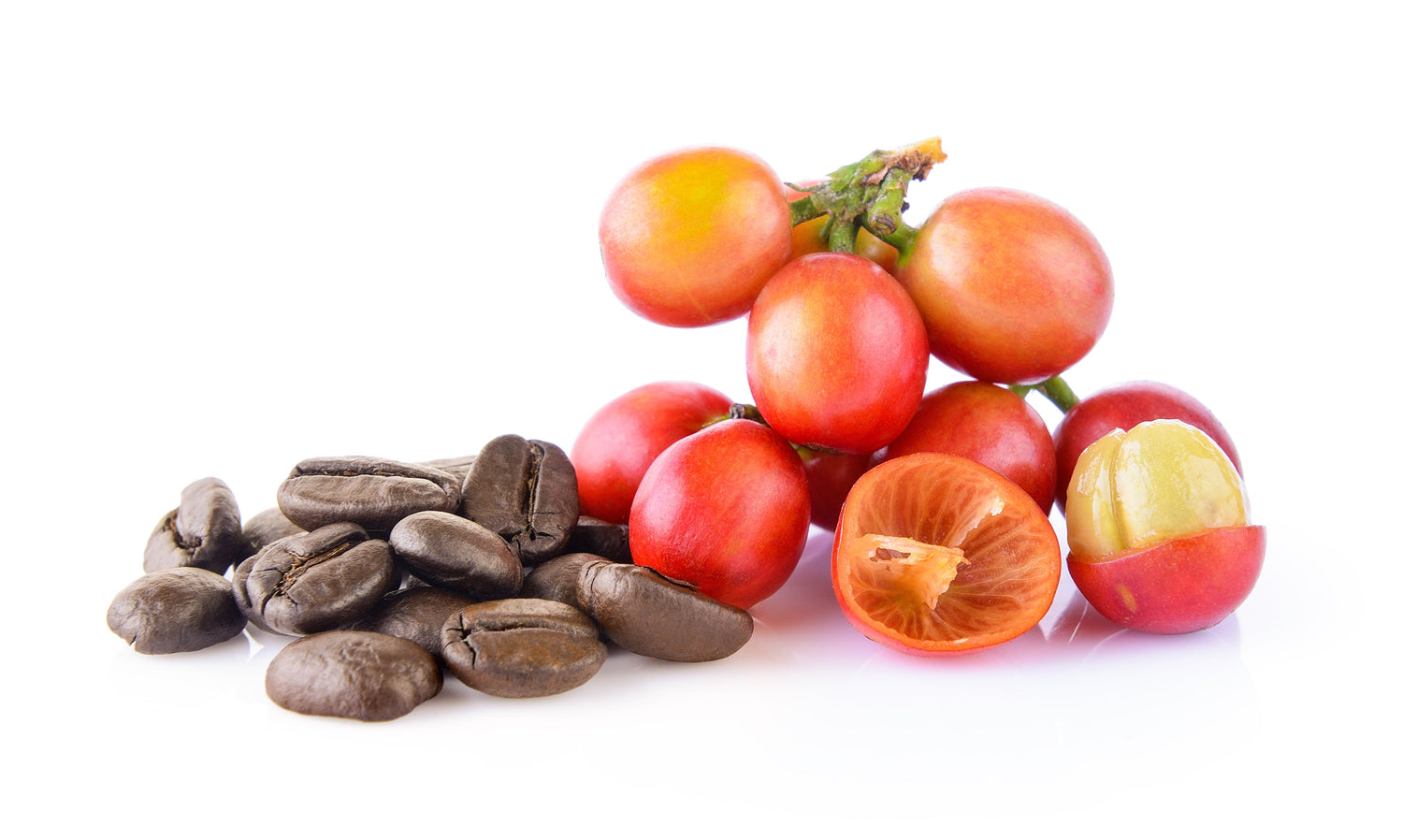
The short version: not all caffeine is created equal. BRAiNLUBE skips the synthetic, lab-made caffeine anhydrous that powers most mainstream energy drinks and builds its buzz from guarana seed and green coffee bean instead — whole-source caffeine that comes with its own supporting cast.
What Guarana Actually Is
Guarana isn't a chemical name someone invented for a label. It's a fruit — a small red berry from a climbing plant native to the Amazon basin, mostly Brazil. Crack one open and you'll find a black seed peeking out of white flesh, which locals have long joked looks a little like an eyeball. That seed is the whole point: it's one of the most caffeine-dense plant materials on Earth, packing several times more caffeine by weight than a coffee bean.
Indigenous communities in the Amazon have used guarana for centuries, traditionally prepared as a paste or drink and reached for during long hunts, journeys, and physical work — the kind of days that demand sustained mental and physical endurance rather than a quick jolt. That's not a coincidence. Guarana doesn't just deliver caffeine; it delivers it alongside other naturally occurring plant compounds, including tannins and small amounts of other mild stimulants, that are thought to influence how that caffeine gets absorbed and used by the body.
Same Molecule, Different Package
Here's where people get tripped up: caffeine is caffeine, chemically speaking. A molecule of caffeine from a guarana seed is structurally identical to a molecule of caffeine synthesized in a lab. So why does the source matter?
Because almost nothing in nutrition happens in isolation. Most energy drinks on the shelf get their kick from caffeine anhydrous — a fine white powder, manufactured synthetically (often from urea derivatives in industrial facilities), then dosed into a formula alongside sugar, artificial flavors, and synthetic colors. It's cheap, it's stable, it's easy to measure precisely. It's also just caffeine and nothing else. No supporting compounds, no matrix, no context — just a stimulant dropped into a can.
Whole-source caffeine, from guarana or green coffee bean, arrives differently. It's extracted from the plant material itself, which means it carries trace amounts of the plant's other natural compounds along with it. Green coffee bean extract, for example, comes from coffee beans before they're roasted — a process that preserves compounds that roasting typically destroys. The caffeine is still the active engine, but it's not riding alone.
"Same molecule. Different ride."
Why This Matters for How You Feel
The most common complaint about mainstream energy drinks isn't that they don't work — it's what happens after. The jittery hands. The racing heart. The crash an hour or two later that leaves you more drained than before you cracked the can. A lot of that experience comes down to how fast synthetic caffeine anhydrous hits your system: it's rapidly absorbed, which means a sharp spike followed by a sharp drop.
This is a big part of why BRAiNLUBE is built the way it is. Guarana and green coffee bean extract are commonly studied and traditionally regarded as offering a steadier release profile compared to isolated caffeine anhydrous, which may translate to energy that feels more sustained and less like a spike-and-crash rollercoaster. Add in the fact that guarana has centuries of traditional use specifically tied to sustained endurance, not just short bursts of alertness, and you start to see why we didn't reach for the synthetic shortcut.
It's also why caffeine source is only half the story in our formula. BRAiNLUBE pairs its guarana- and green-coffee-bean-derived caffeine with L-theanine, an amino acid widely studied for its role in taking the edge off caffeine's jittery side — smoothing out the ride rather than just delivering the punch. That combination is central to what "clean, focused energy" actually means around here: it's not just about which caffeine you use, it's about what you build around it.
Guarana vs. Caffeine Anhydrous, Side by Side
| Guarana / Green Coffee Bean | Caffeine Anhydrous | |
|---|---|---|
| Source | Whole plant seed/bean extract | Synthetically manufactured powder |
| Accompanying compounds | Natural plant compounds carried through extraction | None — isolated caffeine only |
| Traditional use | Centuries of use for sustained endurance | No traditional use — a modern industrial ingredient |
| Commonly associated feel | Often described as steadier, more gradual | Often associated with sharp spike, quicker crash |
Why BRAiNLUBE Went This Route
Every can of BRAiNLUBE delivers 130mg of caffeine — roughly what you'd get from a strong cup of coffee — sourced through guarana seed extract and green coffee bean extract, not caffeine anhydrous. That wasn't the cheap or the easy choice. Synthetic caffeine is inexpensive, endlessly consistent, and simple to formulate with. Whole-source extracts cost more and behave less predictably batch to batch, which is exactly why most mainstream energy drinks don't bother with them.
But BRAiNLUBE was never built to be a mainstream energy drink. It was built by Steve Land, an IT professional who spent years fueled by machine-dispensed coffee through overnight shifts in server rooms, after he noticed something sharper and steadier in an early natural-adaptogen energy drink — one that got discontinued before he was ready to let it go. He and a small team of colleagues spent about two years building the replacement themselves. That origin story is why whole-source ingredients aren't a marketing footnote here — they're the entire premise. Guarana and green coffee bean extract sit alongside taurine, ginseng root extract, ashwagandha root extract, L-citrulline, bacopa monnieri, L-tyrosine, ginkgo biloba, L-theanine, and inositol in the BRAiNLUBE Energy Blend, all working from the same philosophy: real, whole-source ingredients instead of a sugar-and-synthetic-stimulant stack.
None of this means synthetic caffeine is dangerous or that guarana is magic. Caffeine is caffeine, and 130mg is 130mg regardless of where it came from — which is exactly why we stick to the recommended limit of two 12oz cans a day, and why BRAiNLUBE isn't intended for anyone under 18, anyone sensitive to caffeine, or pregnant or nursing women. But when you're choosing what to reach for on the days that actually demand more — deep work, a long drive, exam prep, back-to-back meetings — the source of your caffeine is worth knowing. It's the difference between a jolt and a lift.
Sip smarter. Live brighter.
These statements have not been evaluated by the Food and Drug Administration. This product is not intended to diagnose, treat, cure, or prevent any disease.
